Tuesday, September 30, 2014

Zen and the Art of  Blog Maintenance  Kayaking


Well, friends, you might be wondering what happened. Why another six-plus moths between blog entries? 

It's like this:

The first time I kayaked, ever, I started out in the middle of the Atlantic Ocean. I was in a boat sailed by some friends of friends in northern France, who spoke a dialect of French I didn't know too well. The details of their conversation slipped past me, but somehow it came to one person lowering a kayak into the ocean and me getting into it with him. If I'd had time to think through the situation, or a slightly better command of the language I was speaking, I might have declined and stayed in the sailboat. Luckily, I didn't think or understand too much. 

I know this was a profound experience but--or maybe because--I remember very little of it. I don't remember holding a paddle or what I was sitting on or anything that anyone said or didn't say or how I learned to move the boat in any direction at all. I remember color, an immersion in the shifting turquoise and grayer and greener  blues of the water as I looked down into it and out over it. I know I was kayaking because I can sort-of feel the water shifting as I see the shifting colors, but I can't separate out the elements of the experience--me, the paddle, the contact with the water. All of these things blend as the colors blend. If I concentrate, I can sense my tiredness after paddling and paddling, and my awe at the vastness of the water I was moving through. 

That's it.

This happens. I've got a brain that thinks in big-big-big pictures. I don't know what's what--sometimes for years--when my brain gets going; the scope is too big. I can only watch details slide by and hope to later separate some of them out and assemble them into something that makes sense. 

Sometimes this doesn't happen. I had a plan: I was going to tell you more about yogurt. When I tried to write about yogurt, I remembered kayaking. When I tried to say something about the percussion in Nico & Vinz's "Am I Wrong," I lost my thoughts in the colors of the Atlantic.* 

At one point, I stopped trying to write about yogurt and wrote myself a little note: 

We go along trying to make sense out of things, but is that really the best idea? 

I was pretty sure that this note had something to do with yogurt, maybe the combination of yogurt and kayaking, but it wasn't until today that I got a sense of what's going on. Talking with someone about being authentic--being really-really present in our true selves--I came to understand that my brain (maybe I should say my intuition) is onto a different project these days. I'm not quite sure what it's doing, but the project it wants to work on doesn't seem to line up, exactly, with topics of this blog. It wants to write about how people are drawn to each other. And the rest of me needs to follow it--to stay true to it.

I might be able to shift the focus here and keep writing. Or I might direct you to a new project for a while. Keep checking back; I'll let you know. Meanwhile, what can I say, except, to be our really-really present, authentic selves, we have to follow our own heart-mind?


*I should have paid more attention to the lyrics.

Monday, February 17, 2014


Not-so-simple Addition


Some readers know from last winter that I like to hybridize Hippeastrum, a flowering bulb I grow as a houseplant. One might ask why I indulge in this hobby; hybridizing is nit-picky, time-consuming and patience-testing. Hippeastrum are fairly easy to hybridize, but, partly because of the ease with which they can be led to mingle with each other, most commercially available plants are complex hybrids. (A hybrid is a cross between one species and another species. A complex hybrid is a cross between one species and a hybrid, or a cross between two hybrids.) In complex hybrids, the expression of recessive traits can really surprise a hybridizer.

Four years ago I made a cross that I felt sure would result in red flowers, some with a doubled petal count. The seedlings are blooming for the first time now: pink and orange, single flowers.  I don't know why this happened. 

That's one of the main reasons I like to raise my own hybrids. I know enough about genetics that I'm usually not too surprised. When I am, though, I learn. A lot. About Hippeastrum, about genetics, about my expectations and about the nature of surprise itself. There's also something to learn, here, about addition, the mathematical task so often billed as "simple" but so rarely actually so. Add one thing to another and you get--often enough--a whole very different from the sum of its parts. That is one of the greatest joys of hybridizing

And cooking. Here, too, I know enough that I'm not usually surprised. But, every once in a while, I add one ingredient to another and get something totally unexpected.

Last week I wanted to put together a type of achaar (pickle) made with mixed vegetables, spices,* oil and lemon juice. There are traditional combinations of vegetables, but sometimes I improvise. (It's the hybridizer in me.) I've been doing this for a while, and I know that some combinations make for a good surprise, some, a less-satisfying culinary experience. This time, I used carrots and red bell pepper to balance the green chili pepper, and cucumber to augment the cauliflower. All went as predicted, on that level of "hybridizing."

I was almost done with the project when I realized I didn't have lemon. I can improvise, but I cannot get my mind around achaar without fresh lemon juice. I had a meyer lemon, a sweeter-than-your-typical-lemon hybrid between your-typical-lemon and some kind of orange. My trepidation--achaar needs sourness--was outweighed by my disinclination to schlep to the store in arctic weather. I added the meyer lemon to my complex-hybrid of a pickle.
I can't really describe what this change did to the taste of the pickle, but whatever happened was good. Very good. Next time, I'm going to use meyer lemon again and see if the same thing happens. It might--or might not. You never can tell, with complex hybrids.

I'll leave you with two things:

(1) A complex-hybrid of a song, which some might call "third-wave ska." Ska originated in Jamaica, its first wave already a complex hybrid of both music genres and cultures. It spread to the UK in its so-called second wave (two-tone), a further hybridization of sounds and cultures. Third wave ska exhibits the genre's most dominant trait, a guitar chop on the upbeat, crossed again with different genres, languages and cultures--sometimes with surprising results.

(2) A thought that this complex-hybrid-surprise business happens everywhere, all the time, and not just with genes, sounds and flavors. Ever notice how our personalities change slightly, depending on who we're interacting with or the setting we're interacting in? Different interactions--different additions of people and places--elicit different aspects of our personality. While we can sometimes predict these changes, sometimes there's a real surprise. You just never know--but, sometimes the surprise is quite wonderful.

Let me know what happens if you add (1) and (2) together as an exercise of "simple" addition.


* dry-roasted and ground brown mustard, cumin, fenugreek, cardamom seeds, plus turmeric, cayenne pepper, ginger, asafoetida and salt. Ask me for the recipe if you're curious.

Monday, January 27, 2014

Cure-all


If I had a dollar for every music critic's lament that, nowadays, to be a pop star you don't actually have to be able to sing, I'd have enough dollars to commission my own voice-processing system. Until that happens, there's Auto-Tune, the voice-processing software that offers hope and trendiness to those born with a mediocre vocal range. Can't sing? Auto-Tune can fix that. Not cool enough to be a star? Auto-Tune's got that covered. Boring lyrics? Auto-Tune can help make those cooler, too. It's a by-now time-tested way to make something out of nothing--even old news,* as the Gregory Brothers demonstrate. They make good on their claim: "everything sounds better Auto-Tuned."


Faced with old news in the kitchen--same old recipe, same uninspired stuff in the fridge--it's easy to turn insipid ingredients into rock stars. Add the culinary Auto-Tune: sesame oil. A few drops of this stuff on plain vegetables work magic. If you start a soup by sauteing garlic in roasted sseame oil, your life might n be forever changed.


It would be nice if we could say everything tastes better Auto-Tuned, but of course that's not true. Just as non-stop Auto-Tuned vocals grow tiresome, all-sesame-oil-flavored food, all the time, begins to lose some of its charm. It's worth thinking about how to make something out of nothing, in cooking, singing, and all sorts of other areas. Also worth thinking about: when not to make something out of nothing. It's a fine line between glam-ing up and over-reacting, sometimes. And we all need a little mediocrity mixed in with our rock-star cool from time to time.


What's your culinary Auto-Tune?


*and scary politics

Monday, January 13, 2014

Striking A Chord Or Four


I'm not sure why I first made pulusu, a tamarind-based curry/stew from the Indian state of Andhra Pradesh. I think I was looking for something else (culinarily), came across a recipe for egg pulusu, and decided to give it a try. I got lucky: what I tried, on a whim, had an incomparable combination of flavors. To say it struck a chord with me would be an understatement. I became a pulusu convert, determined to learn to cook at least some of its many variations. 

Chance encounters occasionally take off like that. This dish, though, seems to have an effect on many people around here. Every time I've cooked pulusu for people who haven't tried it before, they've fallen for it as strongly and immediately as I did. Of course I don't know what I'm doing; I learned to cook it by vacuuming--sucking up any and all information I could find on it. I was vacuuming in a vacuum, effectively. At the time, I didn't know anyone who could tell me if I was preparing pulusu correctly, or even what the dish is supposed to taste like.

Chef Sanjay Thumma's explanation helped me to understand pulusu as a base to which one adds different ingredients (eggs or okra or taro or fish or eggplant or bottle gourd or potatoes, for example). I still don't know what I'm doing, but I believe it's a bit like Pachelbel's Canon in D.

Do you like this piece? Does it get stuck in your head? Pachelbel's Canon draws a strong response from most listeners. Many fall in love with it, even the first time they hear it, even if they're not accustomed to hearing western classical music. Even if they don't like western classical music. The piece triggers deep emotions. It's the base--in this case, a ground base of eight notes that repeat throughout.


As Rob Paravonian laments, the ground base in Pachelbel's Canon in D causes some to hate the piece, mostly because they grow bored with its simplicity and repetition. But he and The Axis of Awesome point out something else: this is the base for success. Something about the progression of sound speaks to people, not only in Pachelbel's Canon in D, but also in many, many other places. Master these chords and you'll write a hit song, claim the members of Axis of Awesome in another performance.

It's worth noting that the hit songs use four chords, not necessarily the eight-note ground base. That gives me a great deal of hope. I still don't know if I'm making pulusu correctly, and occasionally my quasi-obsession with "real" things* makes me doubt my efforts. But if I take the four-chord-hit-song-from-eight-note-ground-base as an example, I only need to get about 50% of this dish right for it to be fabulous. That should strike a chord with perfectionists everywhere.


Thanks to my friend Pamela for photos of chili peppers and potatoes
 

*note: not a real obsession


Monday, January 6, 2014

 Learning The Real Deal (or Learning: The Real Deal)


Senegalese griot Lamine Toure leads the drum ensemble Rambax at MIT, providing sabar drum and dance enthusiasts the chance to express themselves. It's always a delight to catch one of their concerts.

I'm in awe of the choices Lamine makes with his students and their performances--how he teaches and translates a traditional art form in a different cultural setting. As someone with constant questions about what's real, I used to be jealous of Lamine's sabar students--not because I yearned to play or dance sabar (although I've enjoyed learning a little from Lamine) but because I wanted a mentor to help me with cross-cultural translation. In particular, I wanted someone to mentor me in traditional  Korean cooking, which I've been learning on my own for five or six years. My wish was granted a few months ago; a friend who studied cooking in Korea offered to teach me. Her skill and talent in the kitchen inspire me unendingly.  

My mentor tells me the reasons behind every step of every Korean recipe. Such knowledge helps me follow directions--something I'm not too good at--and also helps me not follow directions. I believe we can bend rules more wisely (and safely) when we know not only what the rules are, but why they're in place. A little knowledge of why helps enormously in translating, following and improvising. The same can be said for sabar; what Lamine has taught me of the tradition helps me appreciate his choices as he brings it from one culture to another. The best mentors--I count mine among them--know that why is crucial to what and how.

Yet when I cook I sometimes take bloody-minded joy in venturing out on my own, anyway, trying to figure stuff out without knowing what's important or why. And so, guided only by online information, I decided to make a vegetarian version of kongbiji jjigae, ground soybean stew. I made vegetarian kimchee; made vegetarian stock; soaked soybeans and pureed them; sauteed garlic, kimchee and shiitake mushrooms for a few minutes before adding some of the stock I'd made. None of this was new to me. I don't own the stone pot this stew is traditionally cooked in, but I've made that cultural translation before, when cooking other Korean stews. The adventure began when I added in the pureed soybeans. They had the consistency of beaten egg whites, and floated over everything else, resembling a cross between a souffle and a volcano as the stew bubbled up through them.


I followed Maangchi's advice and did not stir the soybeans for a minute or two after I'd added them. Even after I stirred them, though, they floated, resisting all my attempts to incorporate them. Until, without warning, everything deflated. Really: the stew lost half its volume. I have yet to learn whether that's supposed to happen. But, good or bad translation--however authentic, or not, my version was--it was one of the most delicious things I've cooked in a long time. By far.
     
What I'd like to know is why one shouldn't stir the stew immediately after adding the pureed soybeans. I will ask my mentor. I did realize the why of something else, though, through the experiment: why I strike out on my own when I have someone to mentor me. I would have known this easily if I'd seen it in a student; sometimes it's harder to see things in ourselves.

Some students can start with no knowledge, receive information from an expert, and absorb that information. Some can't. I am one who has to learn, on my own, before I can be taught. Because, when studying with social anthropologists, I read about the importance of fieldwork and context for "real" learning experiences, I haven't been giving myself credit for the experiences I have on my own. I feel better about them now.

If we are trying to learn something--anything--one of the most important things to learn, first, is how we learn. Then we can be mentored, as suits us.

Monday, December 30, 2013

The real deal


Last week my friend Mr. Potter commented: 
[A] Scottish Gaelic instructor introduced me to a CD of "The North Shore Gaelic Singers", elderly Canadians of Scottish ancestry who were native speakers of Gaelic, singing Waulking Songs. He said that there's a general feeling among Gaelic Waulking song enthusiasts that they must be sung by old people to sound authentic, which he said is absurd: these songs were formerly sung by people of all ages; it just happens that now Scottish Gaelic has almost died out in maritime Canada.

So I guess if you only ever had experience with behemoth kohlrabis and then you tasted a young one, you might think it wasn't the real deal.


To waulk is to full tweed by hand, bunching and beating it to a rhythm set by a waulking song. When I learned about waulking, in the rather unreal setting of a graduate-school Scottish Gaelic class, I learned a particular pattern of thumping tweed against a table twice, then passing the section I'd worked on to the right, to the student seated next to me. We sang while doing the emperor's-new-clothes version of waulking; we didn't have any tweed to full, but we banged out the rhythm with imaginary cloth in our fists.

Was that an authentic waulking experience? Depends on what counts as real, I'd say, but, based on it, I didn't recognize this song as a waulking song. It has a contemporary base line instead of the sounds of tweed being waulked. After reading the liner notes, though, I could hear how the thump-thump-pass rhythm I learned fits into the song, even into this version. And when I described this version of the song to Mr. Potter a few days ago--I hadn't listened to it in a while and was trying to remember its name--he identified it by the base line. Whether any of that makes it "real," or not, I don't know.*

It's possible--really possible--to back oneself into an intellectual corner over questions of authenticity. In America, "real" brie cheese is imported from France. It's mild, rich, creamy, buttery, and not at all like the brie cheese eaten in France. French brie--I mean brie found in France, not brie found in America that's been imported from France--is medium-brown colored and decidedly stinky. As this slate.com article explains, the difference comes from US government regulations that curtail imported brie's ripening process. You just can't get the real real brie in America. But not to worry: you can get some other kinds of real brie in this country, cheeses with a more authentic (but not really authentic) flavor. Okay, so, if you've only eaten brie in America, which is the real version, the one you experience in real life, or the "real" French one, or the in-between ones?

Sometimes the real thing is the one we knew first. Sometimes, something changes our mind about what's really real, as eating brie in France changed mine. And then, sometimes, something else changes our mind all over again, as reading more about brie in America did mine (again). Sometimes, it's probably a good idea to just enjoy different versions of things as they come along, although I can't help thinking that I enjoy each version more if I understand the history behind--and relationships between--all the versions. What do you think?

A briehemoth!
Real American Brie
Image: http://blogs.etruth.com/takefivewithhaley/2013/04/12/v-top-five-favorite-cheeses/

*The Scottish Gaelic lyrics are in the comments to this video. (Scroll down.)

Tuesday, December 24, 2013

Plus ça change, plus c'est la même chose?


"Old age is not for sissies," said Bette Davis. It certainly isn't. The knees fail, the memory fails. We're not what we used to be. But what was that, exactly? What were we, in the first place, that we've changed from--grown out of or into? It's an endless quest, this trying to find the essence of ourselves. Or of anything, really.

In high school, I liked a band called the Cowboy Junkies. I especially liked a song they sang called Sweet Jane. I didn't know theirs was a cover until years later, when I heard the original Sweet Jane, by Lou Reed. I can't say I liked the original. If we think of covers as the expression of what each artist sees in a song, well, I liked what the Cowboy Junkies saw. I liked the essence they chose to draw out of Lou Reed's piece.
 
I no longer have strong opinions about this particular song and its covers, but covers, generally, fascinate me. They say so much about what we think it's okay to emphasize, to keep or to change. They tell all kinds of stories about what we think is good, what we think is real or authentic.
 
Maybe covers fascinate me because I don't tend to follow recipes too closely. I like to get ideas from other people's cooking, but I modify their recipes based on what I think is the "essence" I'd like to draw out of the recipe or its ingredients. 
 
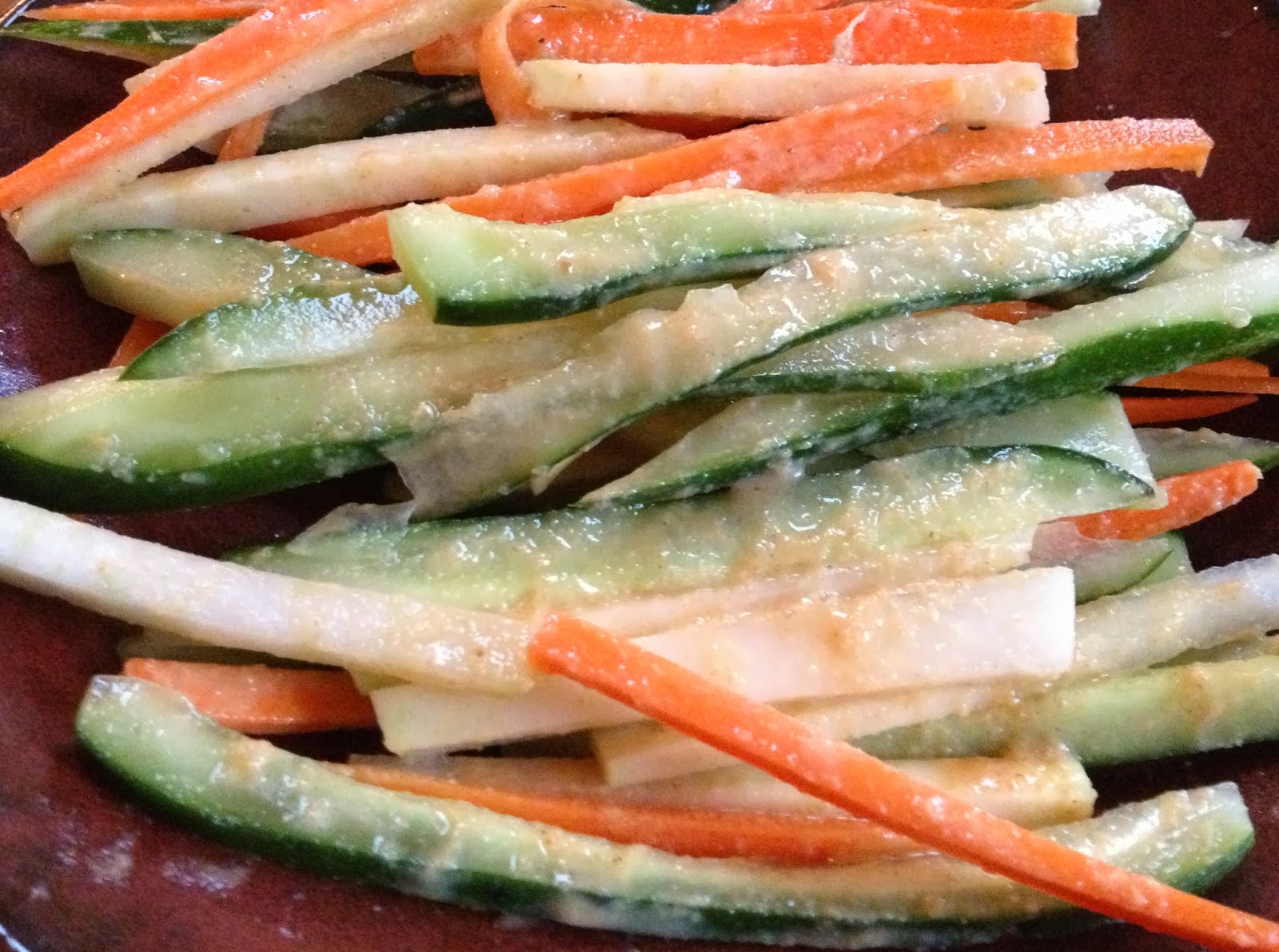
And so, when I saw Maangchi's recipe for cold salad with spicy mustard sauce, I liked her idea of using Asian pear but decided I had something else that would do the trick: kohlrabi. The flying-saucer look-alike of the cruciferous vegetable family, kohlrabi tastes like a cross between a granny smith apple and a salad turnip. All set, I thought, I've got this recipe covered. (I should have known one cannot make bad puns like that with impunity.)

 
I'm used to buying small kohlrabi--an inch or two in diameter--at the farmers' market. Probably, this salad would work well with such very small, very fresh young things. I had something else at hand this time. Boston Organics brought a behemoth: a bigger-than-a-big-grapefruit-sized kohlrabi that had clearly been grown for winter storage, not fresh eating. This behemoth is not for sissies. Not for salads, either. At older stages in its life, I discovered, the vegetable develops an over-cooked cabbage flavor and a slightly spongy texture. 
 
At first I was disappointed. I fixated on how to bring the behemoth back to some semblance of its youth. (What could I possibly add to the salad to get that thing crispier?) Then I realized I was doing it an injustice. I have little patience with people who can't accept their own aging; why should I inflict that worldview on a kohlrabi? 
 
Here is the other way that old age is not for sissies: aging challenges us not only to accept and make the best of what we have at any given time, but also to accept that what we have--our essence, if you like--at any given time differs from what we may have had at another time. What we did to bring out our best at one point in life may not work at another, because we have a different best. Sounds so obvious, but it isn't that easy to do.
 
Musicians, especially vocalists, meet these challenges with varying degrees of grace. Here are the Cowboy Junkies performing Sweet Jane in 2011. I'd say they're not dealing well with their own aging. The arrangement of this version makes me feel the band's trying to be more like a young Lou Reed, here, than they did when they had the oomph and the edge to pull that off. *
 
Here is a no-longer-young Lou Reed performing Sweet Jane.  This has to be the most un-Lou-Reed-like performance I've ever seen from Lou Reed, possibly because he seems so true to himself. 
 
No-longer-young kohlrabi, I discovered, works well cooked lightly with fresh lotus root and a little sesame oil. Something about that combination brings out the best in each of the vegetables, just as they are.

*not to imply that aging entails loss of oomph and edge, every time

Sunday, December 15, 2013

But is it really just a cigar/musician/bowl of soup?


Why is it every cookbook author is also a storyteller? Those lovely blurbs at the beginning of recipes give us something. But what?

When I worked in restaurants, we had cookbooks of a sort: lists of ingredients by proportion, with suggested oven temperatures. There wasn't any information about where the recipe-author first tasted the food, or how it played a part in the author's childhood. We didn't spend any time on telling those kinds of stories. We didn't pinpoint the recipe's cultural origin, trace its history, or suggest ways to serve it.

We did spend time on naming the recipes. I remember a protracted discussion about what to call a soup I made from leftover mushrooms and zucchini. The head chef finally decided to list it on the menu as "Amanda's Summer Vegetable Soup," not because it was inspired by summery vegetables (it was inspired by the need to use up a too-large produce order), not because any of the customers knew who I was (or cared). Rather, he felt that title evoked something--again, I'm not sure what--that would speak to the customers--pique their interest or incite their imagination--and cause them to order the soup.

He had a point. If we'd called it "Uh-oh-these-mushrooms-are-about-to-go-bad-and-crap-we-have-a-lot-of-zucchini-this-week Soup," it might have held less appeal as a menu item. Would it have tasted the same? Of course: flavors are flavors. But there's more to eating, as an experience, than flavor. We could say it involves all our senses, not just taste and smell. I'd say there's even more to it. It involves storytelling.


That we tell ourselves stories all the time seems to me to be a given. Without thinking about it, we connect things with other things, try to situate something in relation to something else. Context helps us. But how much does context affect our experience? And in what ways? How much do we need to know about something in order to enjoy it or fully experience it?

Dave Soldier, co-creator of the Thai Elephant Orchestra, suggests playing the Elephant Orchestra's music to someone--anyone--without mentioning the identity of the musicians, and asking your listener if  what they're hearing is music. Almost everyone will say yes, it's music. Many will guess that they're hearing an East-Asian jazz or fusion band. Tell them it's elephants and all intellectual hell breaks loose.

I was witness to this experiment in a world music class. My co-instructor played a track from the Elephant Orchestra's first CD, without introducing or identifying the piece. She then asked the students what instruments (or types of instruments) they heard, and what they could deduce about the musicians and the performance setting. Nobody, of course, guessed that the musicians are elephants--a good example of how we make up stories, how we supply our own context when we aren't given any.

Just how much context we need is anybody's guess (and a question behind all expression.) For several years, I liked the Elephant Orchestra, but more for the idea of elephant musicians than for the actual music the elephants made. Then I watched this video--long but worthwhile--and heard Dave Soldier and Richard Lair tell the story behind the piece "War." Now that I understand more of that story, I really enjoy the piece, and I hear much more in it. Could I have enjoyed the music without the story? Theoretically, yes. But in fact I didn't.

On the vegetable side of these questions, how many people would relish bitter melon if they didn't understand that it's good for them? I am a strange case when it comes to this vegetable; I truly like its flavor and enjoy eating it. But who knows if I like the flavor because I believe that bitter melon is good for me. I don't remember when I first tried it, but perhaps this food came to me with an especially appealing story.


Miso Soup with Bitter Melon

I could tell you a little about this soup. and maybe relate it to elephants or to ideas about context, but I'd rather you tell me: write me a story (just a few sentences) about this soup. What would be a good way to introduce it? What would you like to know about it--or what can you tell me about its ingredients?

1 small onion
1 small bitter melon
about 3/4C diced winter squash or pumpkin
about 1T peanut or grape seed oil
3-4C water 
3-4t sweet white miso paste (start with about 1 generous teaspoon per cup of water)
 (Make sure you use white miso for this recipe; the flavor of red miso doesn't work nearly as well.)


Cut the onion in half and then slice each half into thin (1/8-inch or so "half moons." Cut the bitter melon in half lengthwise. Use a spoon to scrape out the pithy, seeded center of each melon half. Slice the melon crosswise into half moons of similar thickness to the onion. 

Heat oil and saute the onion over medium heat until it's softened. Keep the heat low enough to avoid browning the onion. When the onion has softened, the bitter melon and the squash (or pumpkin), and enough water to make it look like soup. Keep track of approximately how much water you add. Bring to a boil and cook over medium heat for about ten minutes, or until the melon and squash have softened but are not mushy. Turn off the heat.

In a small bowl, dissolve the miso paste in a few teaspoons of hot water. Add this to the soup, stir, and taste. Different misos vary greatly in saltiness and concentration of flavor, so add a conservative amount, then more, if needed. Serve immediately, with rice or a mix of rice and quinoa if, like me, you've been making a place for quinoa in your diet.


The storyteller in me can't resist adding that I used Indian bitter melon today. I prefer to use Taiwanese bitter melon for this soup, but it's very hard to find Taiwanese bitter melon around here in winter. I'd recommend using it for this recipe, though, if it's available to you.


Sunday, December 8, 2013


Where To Put It?

Any organizer will tell you that stuff needs a place of its own. Without a designated home, the nutmeg-grater will hang out on the counter, or lounge in the dish-drainer after you use it. Without their own space in a drawer or a closet,  homeless T-shirts will slump in a chair or insinuate themselves into the ill-defined textile mass that is probably the clean towels, but it's a little hard to tell because--wait: are there socks in that drawer, too? Stuff piles up; that's its nature. When we establish a home for each bit of stuff, we increase the chances that we will actually get the stuff put away. Makes life more manageable. Makes the stuff itself more manageable, and so, more useable.

In my life, non-physical stuff needs to have its home, too, or it becomes unmanageable, and so, unusable. I had a terrible time meditating anything but very sporadically until I figured out where to "put" meditation in my day.  Some would call this the process of forming a habit, and of course it is, but to me it feels like putting things in their proper place, temporally. Without a home in my schedule, things-to-do might as well be hidden in the mess at the back of a drawer. I don't remember they're there.

  
Every once in a while, I miss something, or remember that I used to use it or do it all the time, and wonder where on earth it went. I root it out and, having learned from those who teach organization, try to find it a proper home. There's  a point in the process when I wander about with the stuff, sometimes literally, wondering where its home should be. (Nope: doesn't fit in that drawer/doesn't fit with the rest of my schedule for Wednesday...Oh! Maybe here...?) It's a bit like (musical) sampling, or so I imagine, if we think of sounds as another kind of stuff. We  start with a really cool or useful or evocative sound. Then we have to figure out where (and/or when) to put it in a piece of music.

At this point in the history of sampling, the integration process is pretty sophisticated, but some early examples have a slightly awkward, "where does this thing go...?" feel to them. Here is Kon Kan, from 1988: I Beg Your Pardon. I think the sampling works on the level of lyrics and ideas, here. Musically, it feels slightly random and pieced together. It's admirable in its own, innovative way, and might encourage those attempting to solidify habits or designate proper homes for stuff; sometimes these things start off feeling awkward, but the process goes more smoothly, becomes more sophisticated and feels more automatic, over time.

Today created places for two homeless things in my life. Blogging and quinoa have been problematic for a while. The problem with blogging: life shifted a bit when my mother moved into town this spring--shifted just enough to tip blogging out of its place. It settled to the bottom of the messy drawer that is my schedule, where I'd occasionally bump into it while searching for something else (yoga class, for example), and miss it, but not actually take the time to make space for it. The problem with quinoa: I haven't cultivated a habit of cooking with it. A bag of it has a physical home in my kitchen, but quinoa doesn't have its own proper place in my meal-planning process.

Solutions came with a recipe for Braised Pears with a Soy-Ginger Glaze from Boston Organics. I wanted to try this recipe for several months, but didn't, because I couldn't think of what to eat it with. It seems to be made for a kind of meat-centered meal I don't eat. I gave up on making it, then realized my friend Sid would have good ideas for accompaniments. He suggested tofu, quinoa. My thought was, "Oh! so that's what to do with the quinoa!" How lovely when these snippets and pieces find a home together, in an evocative song, a daily habit, a good meal, an organized drawer. The whole concept makes me want to get back into the habit of blogging.


We doubled the cayenne and the ginger in the original recipe. We added a dish of tofu stir-fried with garlic, shiitake mushrooms, carrots, scallions and sesame seeds. Quinoa, of course, and some baby kale. The flavors surprised us--equally delicious and unusual, absolutely worth making a place for on a regular basis. The meal was a joint effort, and goes to show how inspiration from  a talented friend not only makes pieces and parts of things find a home together, but also creates a whole much greater than the sum of its parts. 

Saturday, June 15, 2013

Of Shoes and Ships and Real-fruit Snacks and Randomness and Things*


The pop-tart is an exquisite animal. It's a food I think of often because, for some reason, the word "pop-tart" comes to mind when I can't find the word I'm looking for. Stereotyping male celebrities with a friend the other day, I accidentally referred to the ones who show off too many muscles as "pop-tarts"; I was temporarily unable to dredge up the term "beefcake" and my brain filled in the default word. But the allure of the pop-tart lies neither in its muscles nor in its handiness as a substitute for words I can't remember. The pop-tart is exquisite for its artificiality. It's one of those foods which trace their ancestry back to things found in the natural world, but which are are quite a ways out on the branches of that family tree.

Another food in this group is the "real fruit" snack. I'm a little old for the allure of these, but I'm no stranger to the allure of idea behind them. Due to an outbreak of a similar food, the fruit roll-up, when I was little, I've eaten my share of real-fruit-processed-until-it's-no-longer-real. As I remember them, fruit roll-ups retain a faint resemblance to actual fruit. I have found little to no resemblance to fruit in the "real fruit" snacks. These are like the love-children of gummy bears and low-quality peanut butter: sickeningly artificial flavor with a distressingly glommy texture. We could say (especially because I'm having trouble thinking of the right verb as I write this) that, in terms of artificiality, the real-fruit snack out-pop-tarts the pop-tart.
 

I've been trying to understand why we like these not-real-food foods. They're novel, for one thing (until you have one every day in your school lunchbox, as I did, with the fruit roll-up). They're also cute. Their cuteness lies somewhere on what I think of as  the novelty <--> randomness spectrum. I mean, why would anyone come up with foods so weird and un-food-like? And yet people do come up with them, and the foods become wildly popular. **

Such somewhere-between-novel-and-random cuteness comes across clearly in the (unquestionably random) (and unquestionably artificial) (and yet bizarrely appealing) pop-tart cat/nyan cat*** video, reportedly well-known and adored by grade- and middle-school-aged children. A friend who teaches English to sixth-graders sent me the video. I watched it all the way through to the end, but  you don't have to. You'll get all there is in the first few seconds.

I told my friend that I'm clearly too old to be cool. Not only had I not seen this viral video, but also I found myself asking very uncool questions like, "But why a pop-tart?"

He responded:
   
I've expended some energy on the question of why the young are so fascinated with the random.  I see 2 things:

- It's a nihilism, a balm to their feeling of powerlessness.  Fuck authority, parents, everything.  Up pop-tart cats!

- It's the opposite of sincerity / emotional vulnerability.  We're writing poetry?  I'll write about a pop-tart cat.  No way for that to get mushy.  No way I end up crying and laughed at by other kids.


I believe he's onto something important. Randomness has many uses. It can create or highlight artificiality (which has its own appeal). It out-pop-tarts novelty. It can be an escape, a defense, a trap. (Here I think of the entire poem The Walrus and The Carpenter.) Randomness is unquestionably alluring. The patterns we find in it, and the ways in which we use it, can tell us a great deal about ourselves. (Here I think of much of Lewis Carroll's work.)

We could analyze me in this regard: what does it say about me that my brain (apparently randomly) sticks "pop-tart" into gaps left by words I can't remember? But let's be a little more random (or a little less random--you tell me), and, instead, go back to these:


Cute, huh? Some are quite randomly colored, don't you think?


*with apologies to Lewis Carroll and his poem "The Walrus and The Carpenter"

**For example, there is a Pop-Tarts wiki, which says of itself: Pop Tarts Wiki is an in-depth space for you to share your love of Pop-Tarts breakfast pastries. Discover, share and add your knowledge about Pop-Tarts today!

 **The friend who sent the video tells me "nyan" is "meow" in Japanese.

Wednesday, May 29, 2013

How to Make a Classic Timeless

The other day, I was surprised by sappiness.* I was in the middle of doing something I love--picking up and examining every single plant for sale on a large table at my local garden center. I was focused only on the plants. I had forgotten, completely, any troubles held in the world, or in me, personally. I had achieved a meditative, blissful state. I was oblivious to anyone around me, but I was half-listening to the nursery's radio. And so I heard Linda Ronstadt

Let me say, fist (with respect): I am not a fan--not of the song "Long, Long Time," and not of Linda Ronstadt, generally. But, without any warning from myself, I burst into tears less than halfway through the song. Maybe it got to me because I had completely forgotten anything that could have upset me, and so wasn't protecting myself from being upset. Maybe it got to me because, every once in a while, the weirdest, sappiest, cheesiest, most-unlikely things get to us. I have no idea why this happened, but whatever the song unleashed was extreme. 

Several hours later, when I was finally done with my crying fit, I complained to some friends. I don't mind that these things happen to me--surprise emotional attacks happen to most, if not all, of us, and often through unlikely triggers. I do mind that I was somehow moved to tears (lots of tears) by this particular song, a sappy relic of a most unfortunate musical era. 

"It's not a bad song, really," opined my friend Pamela. "The problem, as you said, is that overblown 1970s orchestration. I'd like to hear it sung with just an acoustic guitar (kind of like the version of  "The Long and Winding Road" without all the George Martin orchestration, which was Paul's original conception of the song all along)."  Unfortunately, we weren't able to find a satisfying remake of "Long, Long Time." (Anyone know of one? Any musicians want to try one?) 

I believe my comments about the orchestration had been no more than random potshots. Pamela put it all together brilliantly. Some things need to be lifted from their original context and allowed to shine on their own. Or, maybe, some "classics"--ones that are very much a product of their era--need to be freed from the elements that date them, and allowed to become timeless classics, instead.

So it is with some recipes. I can think of a few from the Victorian era--maybe we'll talk about those another week--but, since we've already tripped lightly back a few decades in America, let's start with green bean casserole. This dish originated in the 1950s. I remember eating it in the 70s (and so it's sort-of linked with Linda Ronstadt in my mind). I hated it then, and, when it surprised me** at some too-traditional-for-me Thanksgiving dinners in the early 2000s, I was unable to feel anything more positive about it.

To echo my friend Pamela, it's not a bad dish, really. The problem is the over-processed arrangement of 1950s convenience foods. This is a dish that cries out for a remake, a cover--anything. 
Unlike "Long, Long Time," green bean casserole has been "remade," many times. Over the past twenty years or so, a panoply of fine chefs has made it into gourmet comfort food. I'd like to separate out a few elements: frozen green beans, mushrooms, some sort of dairy (or dairy-like product), crisp-fried onions.

This is not a casserole. I like recipes that cook faster than casseroles usually do. Is it timeless? I don't know. Maybe it counts as an acoustic version.

Green Bean Casserole This Is Not 


2-3 tablespoons flavorful olive oil
1 onion, sliced in half lengthwise, then each halk sliced into "half moons"
I package frozen green beans (your choice of cut, "French style," etc.)
1/2-3/4 teaspoon whole cumin seeds
i package fresh mushrooms, sliced thinly
salt and freshly-ground black pepper to taste
freshly squeezed lemon juice, to taste
crumbled feta cheese
optional: toasted chopped walnuts

Madhur Jaffrey offers this method for crisp-fried onions:
 Put the oil in a medium saute pan and set over medium-high heat. When hot, add the onion. Stir and fry, turning the heat down as needed, until the onion is reddish-brown and crisp. Remove the onion with a slotted spoon and spread out on a paper towel.***


 These need to cook for about five more minutes

Empty the green beans into a strainer or colander. Run them under hot tap water until they're no longer frozen. Set aside.

 Add the cumin seeds to the hot oil in the pan (you might need to add a little more oil) and stir them for a second or two. Add the mushrooms and cook until the mushrooms release their water. 


Add the green beans, salt and pepper. Cook for a few minutes. The beans will be cooked much less than they are in traditional green bean casserole; that's part of the point. 


Turn off the heat and add a squeeze of fresh lemon juice. You can either put the onions on top, or stir them in. Top with feta cheese and, if you like, toasted walnuts. 


When green beans are in season, use fresh, not frozen. When it's not green bean season, I find the frozen ones are often better. Frozen, we could say, are more "timeless," in some ways.


*with apologies to C. S. Lewis, who was surprised by joy
**surprised by green bean casserole: worse, and far less cathartic, than surprised by sappiness
***from Madhur Jaffrey's World Vegetarian, p. 61

Tuesday, May 7, 2013

A Vegetable in Any Other Language Would Taste as Sweet 


When I first heard the song Why This Kolaveri Di, I had to ask the person who'd introduced me to it what "kolaveri" means. Rage, he explained; it's a Tamil word.That made sense to me. I know what "di" means, and felt I had a reasonable grasp of the song's meaning: why this black rage (sung to or about a love interest).

Not quite. I do know what "di" means, except not in Tamil--not in any language even remotely related to Tamil. "Di," spelled variously but pronounced the same as it is in "Why This Kolaveri Di," means "black" in Celtic languages like Welsh and Scottish Gaelic. In Tamil, it means "girl." That lyric is actually "why this murderous rage, girl?"

My mix-up comes from having learned too many languages; sometimes my brain just gets confused. The song itself is a very different kind of mixed up--no random or confused mixing, here.  It's an addictive mix of a traditional rhythm and newer sampling and music mixing techniques, for one thing.* For another, it's in a portmanteau language, Tamlish (a mix of Tamil and English).

In thinking about the idea of "portmanteau," I began to wonder if it isn't like "culture": all over the place and hard to define or delineate, exactly. It involves mixing, but only partial blending. Each element of the mix retains some of its identity. We see it often at the word level: alphabet (alpha+beta), manscaping (man+landscaping), but words are far from its limit. The concept works with food--brilliantly, here:

Quebexican food

Please, all you punny readers, help me come up with portmanteau recipes like the Quebexican ones. I wasn't quite up to that level this week. But, while making kichdi, I thought of...something.


Kichdi is a very flexible recipe of rice, dal and whatever vegetables and spices you like (or happen to have on hand), cooked together. In some ways, it's like my brain and the "di" mix-up; if you randomly switch out one ingredient for another, the kichdi will still taste pretty much like kichdi. But like "Why This Kolavery Di," kichdi is also mixed more intentionally.  We could say it mixes traditional cooking rhythms with non-traditional ingredients, or that it has, in its nature, the ability to incorporate other mixes and less-traditional elements. In fact mine was a remix. I had an entire pint of leftover rice (an unexpected accompaniment to a take-out dinner) to use up.


kichery (kichdi made with celery) 


1/4 cup hulled and split mung beans
1/4 cup red lentils
1 cup rice (if you're using cooked rice, use two cups and add it later in the recipe, with the vegetables)
1-inch piece fresh turmeric, peeled and grated (or use dried, powdered turmeric)
1 medium-sized potato, diced
1-2 tomatoes (or, if you're like me and you forgot to buy tomatoes, about 1/2 cup tomato puree or unflavored canned diced tomatoes)
about 3/4 small head cauliflower, cut into bite-sized pieces (or, in this case, half cauliflower, half celery, also cut into bite-sized pieces) (or other vegetables)
generous tablespoon mustard or other vegetable oil
1/4-1/2 teaspoon cumin seeds
1 green chili pepper (from an Indian grocery store, or use a serrano chili)
1/4-1/2-inch piece fresh ginger, grated

Assess your green chili pepper. If you have a very hot variety, split it lengthwise but, otherwise, leave it whole. You'll use it for flavoring but perhaps not eat the whole thing (or even part of it--just remove it from teh finished dish). I happened to have only Korean green chilies, which are on the mild side. I decided to slice mine thinly and leave all of it in the kichdi.

Pick over the mung beans and lentils, wash them and put them, with the rice and turmeric, in a heavy-bottomed pot. Add water to cover them by about an inch and a half. Bring to a boil, then simmer for about ten minutes.

Add the potato and tomato. Simmer for ten more minutes.

Add the cauliflower and celery, and about a half cup of hot water. Cook ten more minutes. Check periodically during the cooking time to make sure there's enough liquid; you don't want the dal to catch on the bottom of the pot. This kichdi has a porridge-like consistency.

While the cauliflower and celery cook, heat the oil in a small pan over medium heat. If you've never tempered spices in hot oil before, make sure the pan has a lid, and make sure you're holding the pan's lid in one hand. The lid isn't necessary for this process, but the hot oil may spatter, so you want to be sure you can put a lid on the pan to protect yourself. Test the oil by putting a drop of water in it. The oil is hot enough when the water sputters immediately. At this point, drop the cumin, chili pepper and ginger into the hot oil. Let the spice mixture sizzle for about a minute, then remove it from the heat and add it to the pot of kichdi. Add salt to taste.


My kichdi is undercooked, by traditional standards, especially the vegetables. Such is the delight of a flexible recipe; we can add or adjust to make it a better fit. I would like to think that language is similar. Those who know me have heard me say (more than once, no doubt) that language is an inexact form of communication. I might change "inexact" to "flexible," now that I think about it. Whether through random mix-up or calculated mixing, there's more than one way to say something. And, of course, when it comes to expression, words are far from the limit.


*We'll come back to this particular mix another week


Tuesday, April 23, 2013

Rules and Radishes, Rules and Radishes

 According to my high school Russian history teacher, movie extras in crowd scenes are instructed to mutter "rhubarbs and radishes, rhubarbs and radishes" as they move about,  to simulate crowd noise. I've retained this tidbit through all the years since high school, yet remember nothing of the actual subject of the class. It's not that Russian history is unimportant--it's very important--but, with apologies to William Carlos Williams, so much depends on a red radish. Or a green radish. Or a white or a pink or  a black radish. Radishes matter. So do ideas about how or what to simulate, and what rules to follow to either stand out in a crowd, or blend into one. 

Radishes matter if you follow rules. I am not particularly governed by rules, myself. I follow them when I understand their importance, and have less patience for them, otherwise. For this reason, I'm not usually inclined to follow recipes exactly. Instead, I take great pleasure in going to the farmers' market, buying the best-looking produce, and then figuring out how to adapt whatever recipe I feel like cooking to whatever foods I felt like buying. Except with radishes.

part of the radish selection at Reliable Market in Somerville, MA

Radishes drove me to sign up for deliveries from  Boston Organics last fall.  I wanted a particular type, the watermelon radish. Watermelon radishes are unlike any other radish in my experience. Besides an inimitable hot-pink interior, they have a unique flavor. There's just no substituting for them. They happen to be nearly impossible to find around here after the farmers' markets close in the fall. When I saw that Boston Organics had them in weekly deliveries, post-farmers'-market-season, I signed up immediately.

I stopped the deliveries last week, despite excellent experiences as a customer. I believe it all stopped, just as it started, with radishes.  Boston Organics works a little like a CSA; they deliver their choice of fruits and vegetables each week (although customers do have some choice in what they receive). I was happy to adapt recipes to use whatever vegetables came to me, except for (you guessed it) radish recipes. Even though each week's delivery provided more than a week's worth of produce, I kept buying additional radishes. This time, I wanted Korean radishes--as inimitable, in their own way, as watermelon radishes. I cook a lot of Korean food; I need the right kind of radish. I'm now free to buy them without creating even more of an excess of vegetables here.

Why radishes stand out in a crowd of adaptable, simulate-able vegetables, I don't know, but I realized that they do because of yet another of them. I don't think this one has a specific name in English. It's the 'mooli' in the mooli paratha I hope to learn how to make. I've been making parathe for a while, but, due to my non-rule-governed nature and my habits of adapting recipes, I think it's fair to say that the ones I make are simulations. Now I'm going to learn to make the "real" ones, provided I can find the right kind of radish.

parathe I made with turnip for filling instead of radish

We'll see what happens with "real" mooli paratha. I hope mine will eventually stand out by not standing out--that is, they'll be the way this food is supposed to be.

On standing out in a crowd, and also, not, there's Fritz Kreisler, the outstanding violinist so adept at simulation that his Violin Concerto in C Major (in the Style of Vivaldi) was taken for a "real" piece composed by Vivaldi, as I understand, in part because Kreisler knew which rules of Baroque-era composition to follow.

On being rule-governed,  there's something a friend said, after having spent time on the dance floor at a wedding we attended recently: "Dancing with [another wedding guest] was fun, but I can't really lead or follow. It's the kind of person I am." I could say only, "Yes"; that's the story of my life in dancing, too. But then, not being rule-governed is, itself, a rule to live by--and anyway, as radishes are my witness, we are all governed by some rule or another. That universality, plus the individual rules we follow, make us both stand out and blend in.

more radishes at Reliable Market


Monday, April 15, 2013

Beeting a Dead Horse, Turning 40, and Other Inexplicable Things

Over the past week, readers of this blog have made many excellent beet puns. Out of some sort of misplaced intellectual pride, I wanted to make one, myself, but realized that the good ones had already been taken, and further efforts would be misplaced: beeting a dead horse.

Never mind. I can, theoretically, do whatever I want now because I turned forty today. My friend Sue Spilecki, poet and essayist, once started an essay with the sentence, "Forty is a dangerous age." I can't remember exactly how she phrased the next sentence, something about how, having reached that age, one is finally free to "tell the world to fuck off."

In fact, I don't think I've ever had much trouble telling the world to fuck off, but I've realized lately that sometimes it's better to take a nap than to try to force myself to go to the gym. I believe that's comparably liberating, for someone who occasionally pushes herself too hard. There's a time not to push oneself, a time not to try to do or to understand things.

Because turning forty seems to require some kind of taking stock of life, I thought I'd write about beets and how they can be used in soup stock. (I still haven't given up the beet puns. And anyway, someone asked my opinion on making vegetable stock.) In thinking about it, I realized the process of making stock is like taking stock, like learning a language, like quite a few other things I've been doing lately. One takes pieces--of vegetables, if making stock, but also of a strange language, of memories and information--and does one's best to put them together. At first, they bump up against each other because they're next to each other, but they don't connect or relate to each other. After a while--sometimes a long while--something happens to them. They meld together and form a cohesive whole that is somehow greater than the sum of its parts.

That's the plan, anyway. I know how to make good soup stock, but pieces will be pieces. Sometimes they don't come together into anything cohesive or coherent. Today in the ceramics studio, I struggled to form little pieces of clay into a bowl. Usually, I can do this. Today I was very distracted. I had just learned about the bombings at the Boston Marathon, maybe an hour and a mile away from me. As I thought about the beginning the day, which had been filled with astonishing connections and love in the form of birthday wishes, and then the afternoon of human atrocities, the pieces would not come together.

I didn't make stock. And I don't know what to say about this strange, very happy, very sad day. What I'll say is this, by Julien Jacob. The words of this song don't exist in any language; Jacob makes them up based on his emotions. They are, in some ways, senseless, but they come together to make more sense--a greater whole than parts--than many things.


Tuesday, April 9, 2013

A Fifth of The Way There

I missed the disco era. When I think of things I've missed in my life, I must say I don't feel too bad about this one. Possibly, I don't know any better. Possibly, it's never too late for disco.  Really. Disco seems to have taken on Cool Vintage status, just the timeless classic to mix into a new song (by Phoenix, for example--not new, but newer than the disco era). Of course, the disco era saw some mixing in of timeless classics, too.

Right. Where were we? ("A Fifth of Beethoven" always makes me think, "Oh, Toto, we're really, really not in Kansas anymore, are we?") I'm not sure whether I should apologize for putting you through that musical experience--a particularly awkward one after "Take Five." Bear with me.

Last week, several readers asked me for more under-five-minute recipes. I thought about doling out five more, but realized the key to these is in the building blocks. You need to find yourself a few "timeless" foods--relatively shelf-stable things that take little to no time to prepare. Once you have these, you can mix them into each other, or with other, ready-made foods and seasonings (like hummus, or gochujang).

One of mine: beets. If you have a beet and a small piece of fresh ginger, you can either cut the beet into matchsticks or grate it coarsely. Put it in a bowl with a little minced or grated ginger and microwave for 1-3 minutes. It should be crisp-tender, not fully cooked. If you want to, you can add any of the following: soy sauce, rice vinegar, dark sesame oil, hot sesame oil, salt. This is good with kimchee and rice. (How do you make rice in under five minutes? Cook multiple servings of it on a not-so-busy day. Divide it into individual servings and freeze. Reheat as needed. Or buy fully-cooked, ready-in-ninety-microwaved-seconds rice.)
This works just as well with carrots, turnips or rutabegas if you don't have beets (or don't care for them). You can omit the ginger and flavor it any way you'd like--with grated Parmesan cheese; with olive oil, vinegar, salt and pepper; with walnuts, raisins and goat cheese; with za'atar. You can go anywhere in flavoring this dish. At least I think so.

Personally, I feel that beets can take me farther than disco can, but that's just the kind of person I am. I'm also the kind of person who wonders, possibly too often, about what takes us where. I wonder about that on different levels, and find comfort in all the cliches about the journey being the destination. We might not know where we are, but we're getting there.

Sunday, March 31, 2013

Take Five

Work has consumed my life for the past several weeks.* Not because I'm a supermodel**--far from it--but because my job has its nutty seasons. I look forward to a break, or at least a return to normalcy.

Meanwhile, I'm grateful for crazy-day foods: relatively shelf-stable ingredients that take under five minutes to prepare. As an example, what could you make with any combination of these five foods, in under five minutes?

frozen greens (kale, broccoli raab, spinach, etc.)
frozen sprouted legumes
carrots
frozen cubes of homemade pesto
hummus

What's your take on these five foods? Or what five would you choose?

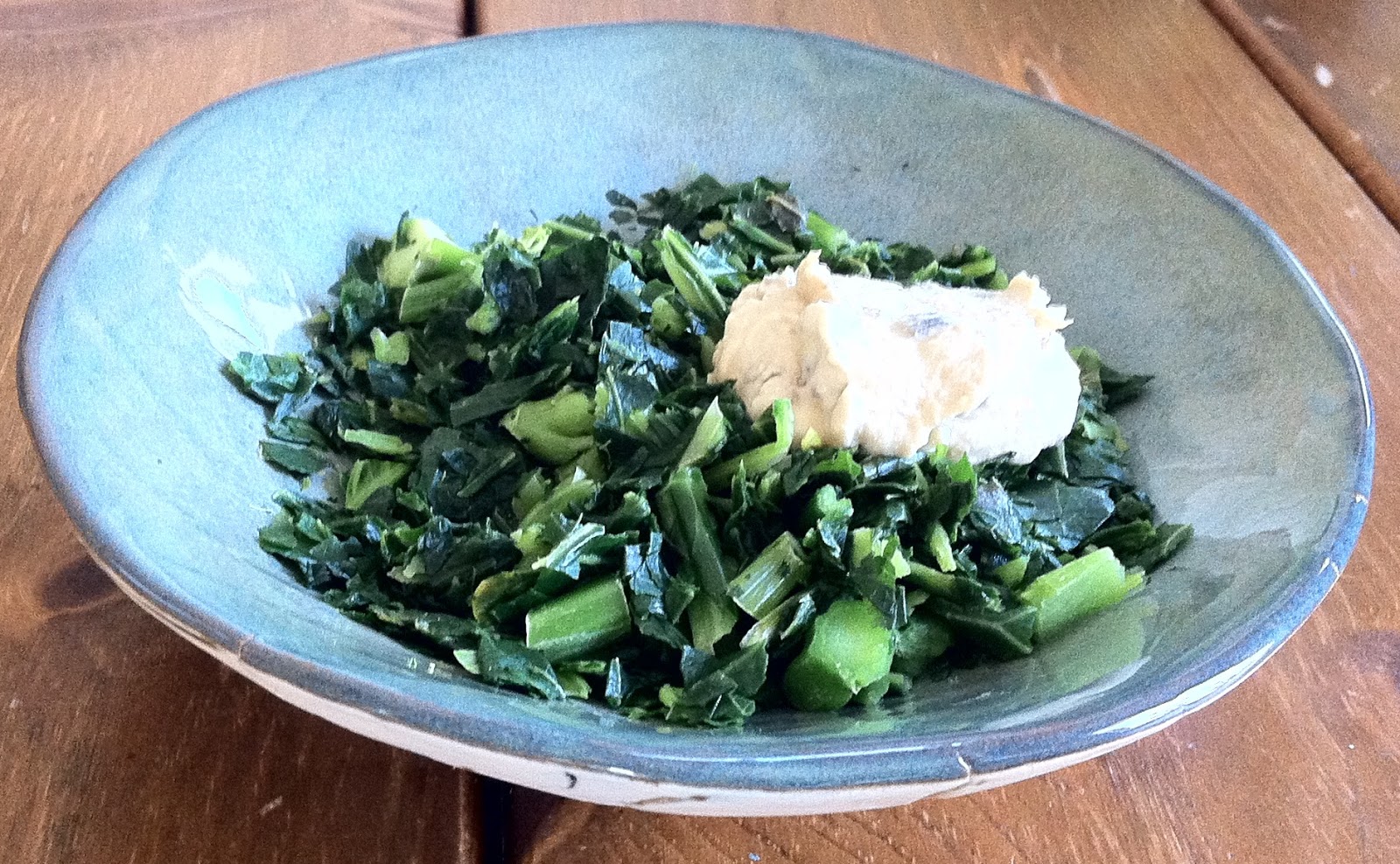
This isn't a joke, and it is possible. Because my schedule gets jumbled, a few times a year, to a point where I really only have a few minutes to prepare food each day, I've developed a slew of recipes like this one: dump frozen greens into a bowl. Microwave for 3-4 minutes. Add hummus to taste. Stir. Serve.


Although super-fast recipes work on crazy, jumbled days, they don't have to be limited to such times. It's helpful to change the rhythm of food prep***--to take a break from the usual. Take Five. Part of the genius of the Dave Brubeck piece lies in its novel rhythm, inspired by Turkish folk dances. Sometimes, that kind of novelty--different pacing--provides just the refreshment we need.


*No time even for blogging! We should be back to the regular, once-a-week schedule now.

**I'm not a model, by any stretch of anybody's imagination. I did have one afternoon of modeling recently, though. I learned a tremendous amount; modeling really is (really) hard work. You can see the results of that day on the front and back covers of this book.

***or of something else, of course, but food prep is one place to start